Take action
$30
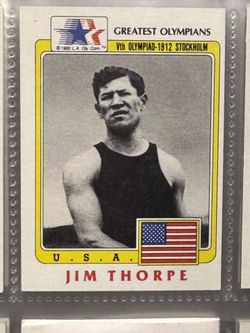
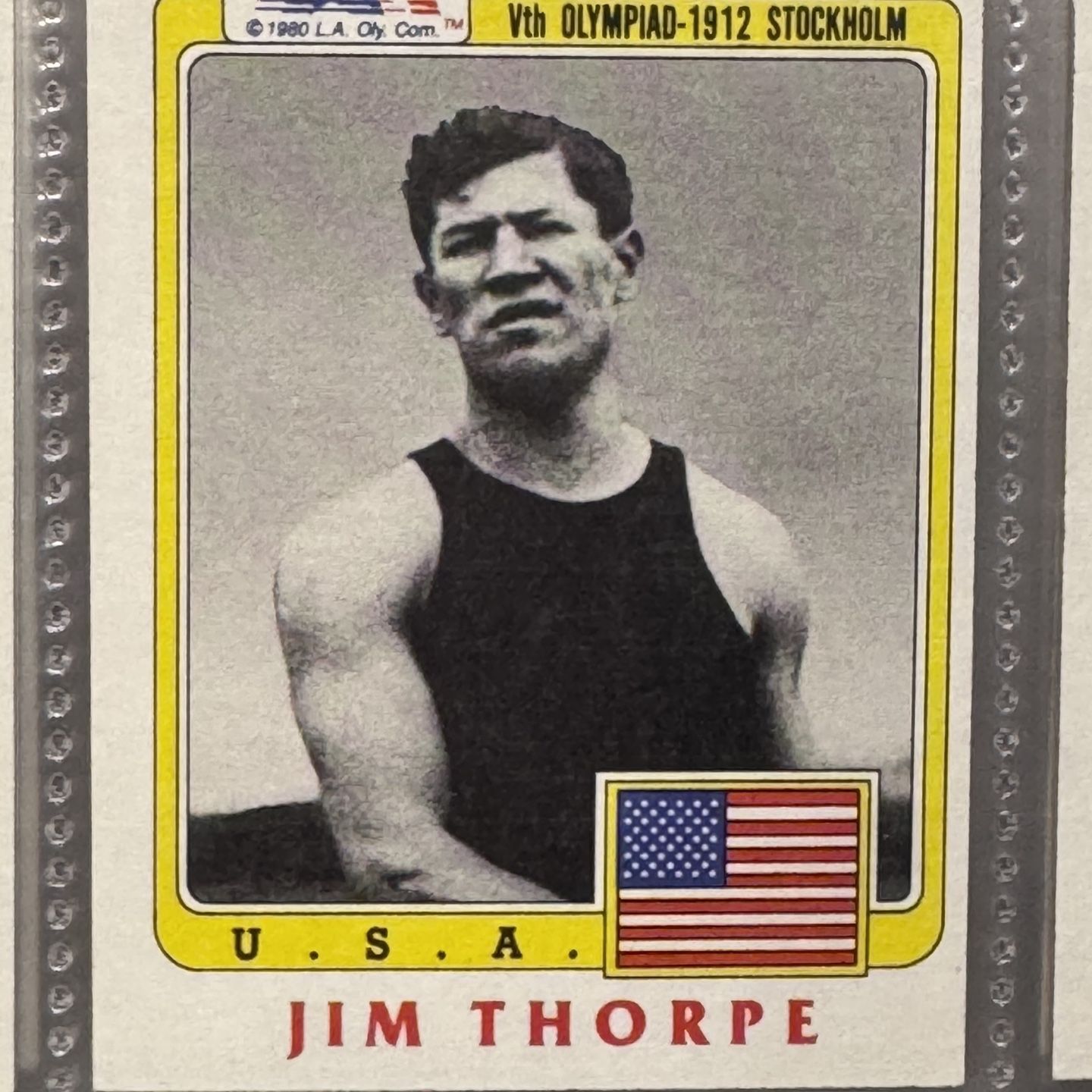
Jim Thorpe Card - 1912 Olympics
Posted in Yorba Linda, CA
Listed in categories:

Chat securely on the app

Additional images
Description
Jim Thorpe (Sac and Fox Nation of Oklahoma, 1887 or 1(contact info removed)) had extraordinary – perhaps even superhuman – powers. He has been labeled one of the greatest athletes of the 20th century. Though best known for the two gold medals he won at the 1912 Olympics, he also played baseball, football, and basketball. In many of the sports he played, he was the captain. Maybe his physical abilities were born of necessity. Certainly, in the days of the late 1880s, there were only wagons and horses to transport one from one place to another. So, you walked. Or ran, to get where you wanted. In 1912, Thorpe was the first 3,000-yard rusher in collegiate football. His record for a drop kick field goal was 87-yards in 1917. Many of his punts were over 100-yards long. In a 1911 Carlisle football game against the University of Pittsburgh, states biographer Robert W. Wheeler, “It wasn’t even his longest punt, but Jim dropped back to his ten-yard line, punted the ball seventy yards, raced down the field, outleapt four Pitt defenders, catching his own punt, raced twenty more yards for a touchdown. He consistently passed the football, punted, and ran farther and faster than anyone of his time. In the ancient Olympic Games, the pentathlon contest consisted of five events: the long jump, javelin and discus throwing, a short foot race, and wrestling. Pentathletes were thought to be the most skilled athletes. The training they did for these five events was part of military service, as each was thought to be a useful skill in battle. At the 1912 Summer Olympics, in the classic pentathlon competition, which consisted of the discus and javelin throw, long jump, 200-meter and 1,500-meter race, Thorpe placed first in all but javelin. The first modern decathlon occurred at the 1912 Olympic Games in Stockholm, Sweden. The modern decathlon consists of ten events: 100-, 400-, and 1500-meter race, 110-meter hurdles, long and high jump, pole vault, discus and javelin throw, and shotput. For both the pentathlon and decathlon, athletes are awarded points for each event. The winner is the competitor that earns the most points. In the decathlon competition, Jim set a world record of 8,412 points – which remained until 1948 – and beat his nearest competitor by almost 700 points. Note that Thorpe won the 1500-meter race wearing mismatched and wrong sized shoes because his shoes were missing, perhaps stolen. One teammate had an extra shoe, but it was too small. Jim squeezed his foot into it. The other shoe he found in a trash bin. It was too big, but Jim put on extra socks to get the shoe to fit. (Smithsonian) Superheroes do what they need to get things done. The following year, Thorpe’s gold medals were taken from him because he had played semi-professional baseball. Like many other athletes did during the summer, he played sports to earn some money. In 1912, strict rules stated that an athlete that received any money, even prize money, was not considered an amateur and was prohibited from competition. In late 1913, the International Olympic Committee (IOC) decided to strip Jim of his title, medals, and awards, and declared him a professional. Some believe his ethnicity as an American Indian had much to do with this even though Thorpe had represented a country in which he was not yet a citizen. That would not come for another 11 years; American Indians were granted citizenship in 1924. It took 70 years for Thorpe to be reinstated by the IOC. He was made a co-winner with Ferdinand Bie of Norway in the pentathlon and Hugo Wieslander from Sweden in the decathlon. After a 2020 campaign that included a petition that gathered more than 75,000 signatures, the IOC reinstated Thorpe as the sole medalist – as he rightly was – of the pentathlon and decathlon on July 14, 2022, 110 years since he won the medals. The 2018 coin recognizes the accomplishments of Olympian and multi-talented athlete Jim Thorpe. The reverse (tails) design depicts Thorpe with foreground elements highlighting his football and Olympic also available are: #Dan Gable #Joe Frazier
Details
Condition
New
Item location map
Map is approximate to keep seller’s location private.