Take action
$150
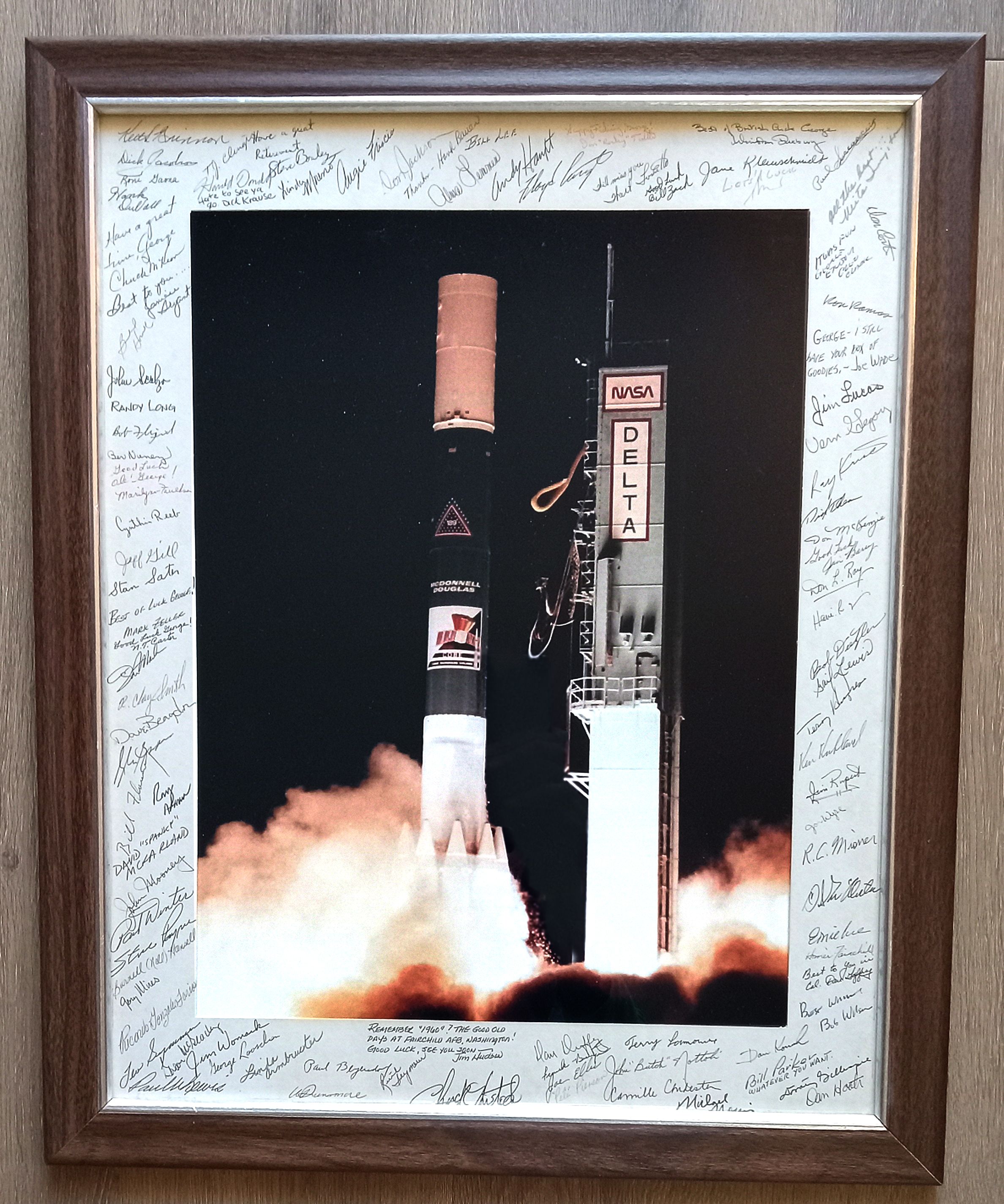
989 NASA DELTA ROCKET Delta-5920 D-189 Launch Hand Signed
Last updated 3 days ago in Everett, WA
Listed in categories:

Chat securely on the app

Additional images
Description
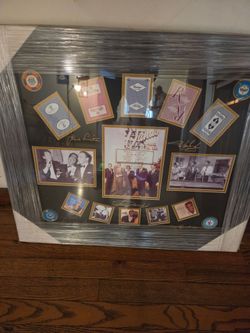
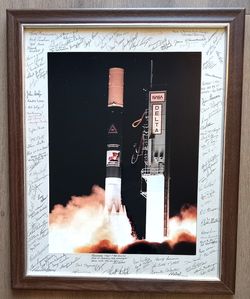
Very rare, one of a kind. Came from an Boeing engineer estate. Signed by 90+ employees of the project. A retirement memento. I live in a large apartment building, I can bring it down to the lobby for you to see. Thank you. 22 inch x 18 framed. Launch of the Delta 5920 (Delta 189) with the Cosmic Background Explorer (COBE) satellite. The Delta 5000 was launched just once, from Space Launch Complex 2W at the Vandenberg Air Force Base. Launch occurred at 14:34 on 18 November 1989. It was successful, and placed the Cosmic Background Explorer (COBE) spacecraft into low Earth orbit. The photo is a chromogenic print on Kodak paper, (16 x 12in), with "This Paper Manufactured By Kodak" watermarks. The Delta 5000 series was an American expendable launch system which was used to conduct an orbital launch in 1989. It was a member of the Delta family of rockets. Although several variants were put forward, only the Delta 5920 was launched. In 1974, George Smoot submitted a proposal to NASA to launch a satellite designed to measure the microwave background with unprecedented precision. It was eventually merged with others, and he teamed up with Mather. COBE launched in 1989 after 15 years of development. More than 1,000 people contributed, including a 40-member team at Berkeley Lab. In-house Goddard Team: Unlike many NASA missions, COBE was an "in-house" project, meaning much of the complex engineering and instrument construction was performed directly by NASA civil servants rather than private contractors. "After we won the GPS launch contract, that was when everything really went crazy," said Randy Long, who served as a propulsion engineer for McDonnell Douglas when the Delta II was selected. The GPS program would see 47 Delta II launches from 1989 to 2009. delta-5920 18-Nov-89 1434 189 COBE (Explorer 66) * # 5920 NASA Success 2W* 4857 COBE's measurements provided two key pieces of evidence that supported the Big Bang theory of the universe: that the CMB has a near-perfect black-body spectrum, and that it has very faint anisotropies. Two of COBE's principal investigators, George F. Smoot and John C. Mather, received the Nobel Prize in Physics in 2006 for their work on the project. According to the Nobel Prize committee, "the COBE project can also be regarded as the starting point for cosmology as a precision science".
Details
Condition
Used (normal wear)
Item location map
Map is approximate to keep seller’s location private.